7 Best Heat Exchanger Materials for Global Buyers
Selecting Heat Exchanger Materials is a practical decision, not a simple price comparison. Global buyers must balance thermal conductivity, corrosion resistance, pressure tolerance, fabrication, and lifecycle cost. A bright stainless-steel tube may look dependable, yet chloride-rich water can still create costly pitting. Service conditions matter more than appearance.
The International Energy Agency’s Energy Efficiency 2023 report indicates that industry consumes roughly 37% of global final energy. Efficient heat recovery therefore has measurable commercial importance. Grand View Research estimates the global heat exchanger market was worth approximately USD 18 billion in 2023, with continued growth expected through 2030. These figures signal demand, but they do not identify one universal material. That assumption needs reconsideration.
Professor Sadik Kakaç states, “A heat exchanger is a device that transfers energy from one fluid to another.” His principle sounds simple. Material selection is not. Stainless steel often suits hygienic processing and general chemical service. Copper alloys support strong conductivity in water applications. Titanium withstands seawater well, while nickel alloys protect demanding high-temperature systems. Aluminum can reduce weight, and graphite offers valuable chemical resistance. Carbon steel remains attractive where budgets and operating conditions are moderate.
This guide compares seven widely used options for international procurement teams. It considers performance, manufacturing realities, maintenance exposure, and total ownership cost. Standards, certificates, and supplier testing still require careful verification. Data sheets can be incomplete. Field experience can disagree with laboratory results. A suitable choice begins with fluid chemistry, temperature, velocity, pressure, cleaning methods, and consequences of failure. That discipline helps buyers avoid expensive substitutions and premature tube replacement.
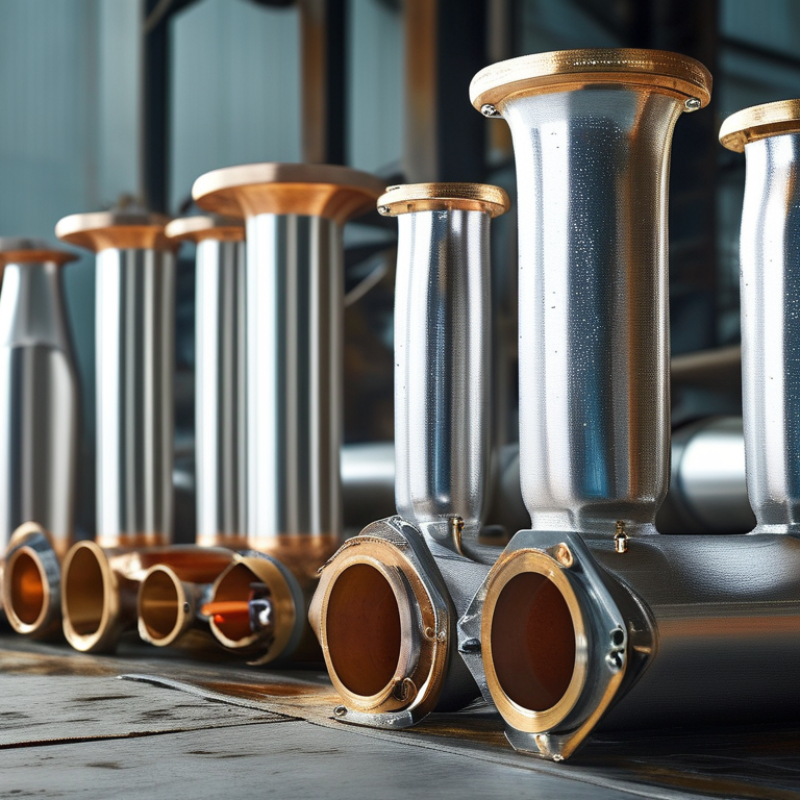
Buyer Criteria: Compare 15–400 W/m·K Conductivity and Corrosion Resistance
7 Best Heat Exchanger Materials for Global Buyers
Material selection starts with thermal conductivity, but conductivity alone can mislead.
Copper delivers about 380–400 W/m·K, making it effective for compact exchangers and fast heat transfer.
Aluminum usually provides 150–235 W/m·K with lower weight and easier handling.
Graphite can reach 80–200 W/m·K, depending on its structure and direction of heat flow.
These options suit clean fluids, but copper and aluminum may suffer in acidic, salty, or ammonia-rich environments.
Stainless steel offers roughly 15–30 W/m·K and strong general corrosion resistance.
Titanium provides about 15–22 W/m·K, yet performs well in seawater and chloride service.
Nickel alloys commonly reach 60–90 W/m·K and tolerate demanding chemical conditions.
Silicon carbide can deliver approximately 100–250 W/m·K, with excellent resistance to abrasion and aggressive fluids.
It is also brittle. That detail matters during transport, installation, and sudden temperature changes.
Tips:
Match conductivity with the actual fluid, pressure, and operating temperature.
Check welds, joints, and cleaning chemicals, not only the base material.
Request corrosion data from controlled testing when possible.
A laboratory value may not reflect fouling, flow velocity, or local pitting.
In practice, I would compare lifecycle cost before choosing the highest conductivity.
The fastest material is not always the safest purchase.
Some assumptions fail.
Copper and Aluminum: 205–401 W/m·K for Compact Heat Exchanger Designs
7 Best Heat Exchanger Materials for Global Buyers
Copper and aluminum remain practical choices for compact heat exchanger designs. ASM Handbook, Volume 2, lists copper thermal conductivity near 385–401 W/m·K, while aluminum commonly reaches 205–237 W/m·K. Copper transfers heat faster. Aluminum weighs much less. That difference matters when equipment must fit inside a narrow cabinet or move between sites. The International Energy Agency’s The Future of Cooling report projects cooling energy demand could more than triple by 2050. Compact, efficient exchangers will therefore face stronger demand.
In field selection, I check more than conductivity. Copper tubes often suit high heat-transfer duty and repeated temperature changes. Aluminum fins reduce mass and can improve air-side performance. However, moisture, chloride exposure, and galvanic contact may shorten service life. A neat laboratory number can still fail in a humid plant. This is where my own selection process needs a second check.
Supply also affects global purchasing. The U.S. Geological Survey’s Mineral Commodity Summaries 2024 reports roughly 22 million metric tons of mined copper and about 70 million metric tons of primary aluminum production in 2023. These figures suggest broad material availability, but they do not guarantee stable prices or equal regional access. Buyers should verify alloy grade, wall thickness, joining method, and coating compatibility. Aluminum may win on weight. Copper may win on thermal density. Sometimes, neither is ideal.
Carbon Steel and Stainless Steel: 15–50 W/m·K with Proven Durability
For global buyers, heat exchanger material selection begins with operating conditions, not price alone.
Carbon steel and stainless steel typically provide 15–50 W/m·K, depending on grade, temperature, and manufacturing condition. Carbon steel generally transfers heat efficiently and offers strong mechanical performance. Stainless steel often has lower conductivity, but it resists oxidation and many corrosive fluids more effectively.
Conductivity matters. Durability matters more.
Carbon steel suits many water, oil, and moderate-pressure services. Its weldability can simplify fabrication and repairs. However, untreated water, dissolved oxygen, and acidic contamination may accelerate corrosion. Stainless steel forms a protective chromium-rich surface, making it valuable for humid, sanitary, or chemically demanding systems. Chloride exposure can still cause pitting, especially in warm stagnant zones.
That risk is often underestimated.
Experienced buyers should compare thermal conductivity with pressure, fluid chemistry, temperature cycles, fouling, and cleaning methods.
Tube thickness also affects heat transfer. A thicker wall may improve service life while reducing exchanger efficiency. Procurement teams should request mill certificates, inspection records, weld procedures, and corrosion allowances. Standards and local code requirements need verification before production. Carbon steel may appear cheaper in a spreadsheet, yet coating, maintenance, and downtime can change the real cost. Stainless steel is not automatically the safer choice either. Its higher purchase cost can be wasteful when the fluid is clean and non-corrosive.
Careful material testing remains necessary.
Titanium, Nickel Alloys, and Graphite: 17–400 W/m·K for Harsh Media
For global buyers, thermal conductivity is only the opening filter. ASM Handbook data place common exchanger materials across roughly 17–400 W/m·K. Copper can approach 400 W/m·K, while aluminum reaches about 205 W/m·K. Graphite varies widely, often from 70 to 400 W/m·K, depending on grade and direction. Titanium commonly sits near 17 W/m·K. Nickel alloys may remain below 20 W/m·K, but they tolerate aggressive media and high temperatures better. Stainless steel and zirconium usually offer moderate conductivity, near 14–25 and 22 W/m·K, respectively.
Harsh service changes the decision. Titanium suits chloride-rich water, while nickel alloys support hot acidic streams. Graphite handles strong chemical exposure, yet its brittleness demands careful transport and tube design. Copper transfers heat quickly, but corrosion can become decisive. Aluminum is light and efficient, although it needs disciplined media screening.
The U.S. Department of Energy’s Industrial Decarbonization Roadmap reports that process heating represents about 51% of manufacturing energy use. Small exchanger losses can therefore become expensive.
My practical hesitation is simple: conductivity tables can mislead.
A graphite exchanger rated near 400 W/m·K may perform poorly after fouling or mechanical damage. A nickel alloy with lower conductivity may deliver longer service. Buyers should compare temperature, pressure, fouling resistance, weldability, inspection access, and lifecycle cost. The cheapest material is not always the economical choice.
Global Selection Matrix: Evaluate Pressure, Temperature, ASTM Standards, and Cost
Global buyers should compare heat exchanger materials against pressure, temperature, corrosion, standards, and total cost. Carbon steel, commonly specified under ASTM A516, offers strong pressure capability at moderate temperatures and the lowest purchase cost. Stainless steel, such as ASTM A240 grades 304 or 316, improves corrosion resistance but costs more. Duplex stainless steel, covered by ASTM A790, suits chloride exposure and high mechanical loads, although welding control is demanding.
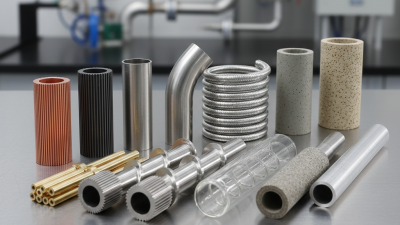
Nickel alloys, titanium, copper alloys, and graphite complete the practical seven-material matrix. Nickel alloys handle severe heat and aggressive chemicals, but their price can rise sharply with nickel market changes. Titanium, often supplied to ASTM B265, performs well in seawater service, yet fabrication requires experienced technicians. Copper alloys deliver excellent thermal conductivity, while graphite resists many chemicals but remains vulnerable to impact and pressure shock. These choices should be checked against ASME BPVC Section VIII design rules, not selected from catalog temperature ratings alone.
NACE’s IMPACT study estimated global corrosion costs at approximately US$2.5 trillion annually, equal to about 3.4% of global GDP. That figure supports lifecycle evaluation, especially where fouling or leakage can stop production. Costs drift. A low-cost shell may demand frequent cleaning, coatings, or replacement. ASTM compliance also needs verification through material certificates, weld records, and hydrostatic testing. The matrix is useful, but fluid chemistry, thermal cycling, and local inspection practice can still overturn the initial ranking.